





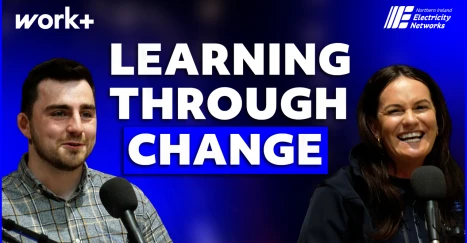
Sinéad Norwood never expected to end up as an engineer. She spent ten years working at Next, trained as a classroom assistant, and was sitting in on a careers session with her pupils when she noticed them filling in applications for NIE Networks apprenticeships. On an instinct, she put in an application herself. That decision, aged 26, changed everything.
Today, Sinéad is a SAR Engineer at NIE Networks, responsible for secondary asset replacement across the network. NIE Networks supported her through an electrical engineering degree at Queen's after her apprenticeship. She now holds a senior authorised person qualification and switches the high voltage network on and off for safe working every day.
Joel McCreery's route was more conventional, but no less driven by curiosity. He picked up a Queen's engineering brochure at the back of a classroom one day and worked his way through it until one page stopped him. He studied electrical engineering at Queen's, went on placement at SONI, and joined NIE Networks' network innovation team straight after graduating.
Two Routes, One Organisation
Their paths into NIE Networks could not be more different, but both tell the same story: that this is an organisation where there is room for people of different ages and starting points. Sinéad's cable jointing cohort included two other mature students and two other women.
"Everything in my life has brought me to where I am now," Sinéad reflects. "Even when I was a classroom assistant, if I had not taken on that job, I would not be sitting here. Just go with your gut. You will get there eventually."
The Work No One Thinks About
Ask most people what NIE Networks engineers do and they will probably picture someone up a ladder. Cable jointers, Sinéad explains, do the opposite. They work underground, joining the cables that carry electricity beneath Northern Ireland's streets.
"Nobody thinks about electricity until there is a fault. And then you go, oh, where is it now? That is when we get called."
Joel's work is less visible but equally vital. The network innovation team is trying to solve one of the central challenges of the energy transition: how to accommodate growing demand from electric vehicles and heat pumps without rebuilding the entire network from scratch. Flexibility services, where businesses and factories adjust their demand or generation in response to signals from NIE, are one of the tools being tested.
Resilience Is the Real Qualification
Both Joel and Sinéad return to the same theme when asked about the skills that matter most. Communication. Problem-solving. Safety. And above all, resilience.
"I would say resilience is probably the key one," Joel says. "The project will not look exactly how you thought it would look, and that is okay. The project has evolved. It has taken on board feedback. Being adaptable and able to take all of that on board is really, really key."
For Sinéad, that resilience was forged long before she arrived at NIE Networks, in a decade of customer service at Next, in a social work course she ruled out after three months, and in a classroom full of teenagers who unknowingly pointed her towards her future.
Endless Possibilities
What both engineers love most about their work is its variety. No two days are the same for either of them. For Sinéad, that means moving from an underground shutdown in the morning to a community forum in the afternoon. For Joel, the problems he is solving now bear little resemblance to the ones he was working on when he joined four or five years ago.
For young people, parents and teachers thinking about careers in engineering or energy, their story makes one thing plain. You do not need a fixed plan at sixteen. You just need curiosity, a willingness to learn, and the readiness to say yes when an opportunity appears, even if it turns up in a careers session you were running for someone else.
Watch the full episode: https://youtu.be/hNkHPHms2BE