







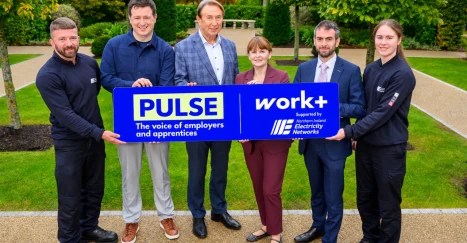
Pictured with Economy Minister Dr Caoimhe Archibald MLA at the launch of the Workplus Pulse survey results, supported by NIE Networks, are (from left) Edward Lynn (NIE Networks), Richard Kirk (Workplus), Gordon Parkes (NIE Networks), Stuart Anderson (NI Chamber) and Hayley McFerran (NIE Networks). Edward and Hayley are both Overhead Lines Apprentices with NIE Networks.
The findings were revealed at NI Chamber’s Future Workforce Summit – an event for employers, educators and policymakers to explore how the next generation will transform the world of work.
The 2026 Pulse research brings together the views of employers and apprentices to provide a snapshot of how apprenticeships are performing and where the system needs to improve.
The 2026 Employer Pulse and Apprentice Pulse surveys find 92% of apprentices confident about their careers, while 89% of employers say apprenticeships strengthen their talent pipeline.
Apprenticeships are delivering high levels of satisfaction, retention and career confidence for both apprentices and employers in Northern Ireland, but further action is needed to increase opportunities and make the system easier to navigate.
Among over 200 apprentices surveyed, 92% rated their confidence in their future career prospects four or five out of five, while 87% gave their employer the same high rating. Apprentices recorded a Net Promoter Score of +70, indicating a very high likelihood of recommending the apprenticeship route to others.
Employers were similarly positive. 89% said apprenticeships benefit their talent pipeline, 71% retain at least three-quarters of each apprentice intake, and nearly three quarters - 73% - believe the benefits of apprenticeships outweigh the costs.
The findings also show significant demand for people and skills. 87% of employers expect definite or possible staffing needs over the next 12 to 24 months, with engineering and manufacturing, digital and technology, leadership and management, and construction among the areas of greatest anticipated demand.
Richard Kirk, Founder and CEO of Workplus, said: “Taken together, these results give us real confidence in the apprenticeship model. Apprentices are positive about their employers, their careers and their future, while employers are seeing strong retention and a valuable pipeline of talent.
“But the research also gives us a clear challenge. If we want more employers and more people to benefit from apprenticeships, we have to create more opportunities, make apprenticeships easier to find, easier to understand and more straight-forward for employers to deliver.
The focus now needs to be on increasing the number and range of opportunities, promoting them much earlier, making recruitment simpler, strengthening mentoring and ensuring learning keeps pace with the workplace.”
Gordon Parkes, Chairman of Green Skills Delivery Group and People & Culture Consultant, NIE Networks said: “Supporting the development of Northern Ireland’s future workforce is hugely important to us at NIE Networks and more widely for the future of Northern Ireland.
Having significantly invested in and developed our Investors in People Platinum award-winning Apprentice Academy over the last 50 years, we understand the value that can be delivered through apprenticeship pipelines. Indeed, the findings confirm what we at NIE Networks believe, 89% of employers feel the real benefits of having a strong apprentice pipeline, over 30% of our senior managers came through our apprentice programme so this is something we really believe in.
Demand for green skills apprenticeships is growing and with an estimated 58,000 roles expected across Northern Ireland over the next 10 years it is important there is a collective effort to develop and deliver the skills needed at scale and at pace.
The outputs from the 2026 surveys will continue to provide policymakers with a credible, employer-led and apprentice-informed evidence base and identify what is working, where the system remains difficult to navigate, what support employers need to expand provision, and how early talent programmes can play a greater role in Northern Ireland’s future workforce strategy.”
Commenting on the findings, Suzanne Wylie, Chief Executive, NI Chamber said:
“It is clear from the survey that apprenticeships offer employers a valuable opportunity to access talent, invest in their future workforce and develop capability, which ultimately strengthens their competitiveness. It is also clear that apprentices themselves value a route to employment which gets them 'work ready'.
At a time when many of our members report recruitment challenges, these findings reinforce the important role apprenticeships play in helping businesses build the skills and talent they need to grow. We now need to create more opportunities and simpler pathways to scale up and at pace."
Apprenticeships increasingly competing with full-time university
One of the strongest findings from the Apprentice Pulse survey is that apprenticeships are increasingly being chosen as a first-choice alternative to full-time higher education rather than as a fallback option.
62% of apprentices said they would most likely have gone to university full-time had they not secured an apprenticeship. A further 28% said they would have entered full-time employment, while only four respondents said they would otherwise have been unemployed.
The financial progression reported by apprentices was also significant. Among respondents who provided comparable salary information, average pay increased from £20,897 when they started their apprenticeship to £25,988, an average increase of approximately £5,090.
Employers see the value – but struggle to measure it
The Employer Pulse found that businesses continue to recognise apprenticeships as a valuable way of building their future workforce. Talent-pipeline development was identified as a benefit by 89% of employers.
Retention also remains strong, with 71% retaining at least 75% of apprentices and almost one-third retaining more than 95%. Some 88% said apprentice retention was the same as or better than retention among their wider workforce.
However, the research highlighted a gap between employers recognising value and formally measuring it. While 73% believe the benefits outweigh the costs, only 5% have formally measured that value. Almost half – 48% – do not currently measure the value of apprenticeships but would like to.
Operational challenges feature prominently. 60% identified line-manager time and resources as a challenge, while 55% highlighted recruiting suitable candidates.
Government incentives remain the most frequently requested intervention, cited by 53% of employers, followed by more apprenticeship pathways and a simpler process.
Getting an apprenticeship remains a challenge
While apprentices are highly positive once they enter their programme, the research suggests that finding an opportunity can remain difficult. Although 78% said finding a suitable course was easy, this dropped to 73% when asked about finding an employer. Competition for opportunities emerged as a recurring concern, with three in ten respondents spending ten hours or more completing apprenticeship applications.
Family support also plays a disproportionately important role. 60% said parents or carers had helped them “a lot”, considerably ahead of support received through schools, careers services or other sources.
Asked what should change, the most common suggestion from apprentices was earlier promotion of apprenticeships in schools. They also called for greater employer involvement, a wider range of sectors, more flexible learning and clearer and more centralised information.
Mentoring matters
Workplace mentoring emerged as another important theme. 71% of apprentices said they have a workplace mentor, and those with mentors reported stronger outcomes across a range of measures. The quality of those relationships is generally strong, with 97% of apprentices with mentors saying they feel able to ask them questions.
Learning experience needs to keep pace
The research also points to a difference between apprentices' workplace and learning experiences.
While 87% rated their employer highly, satisfaction with learning providers was 77%. Communication, course relevance and how well learning fits around the job were among the recurring areas identified for improvement.
Employers raised similar concerns. Only 32% agreed that apprenticeship off-the-job training is keeping pace with changing industry and technology needs.
Despite this, confidence in the future of apprenticeships remains high, with 83% of employers expecting apprenticeships to remain as important or become more important to their organisation.
The surveys also highlight the growing influence of artificial intelligence and digital technologies. 89% of apprentices believe their apprenticeship is preparing them for the future world of work, although only 68% say they currently use AI, automation or digital technologies in their day-to-day role. Among employers, 36% expect AI to increase demand for entry-level workers, 17% expect it to reduce demand, and 30% remain unsure.
Download full survey reports here