Apprenticeships
Earn early. Study fee-free. That's our plus.
Leaving school or thinking about a career change? Earning and learning with an apprenticeship could be your best next step.
Find out more




Login here
Login

Take your next step.
Login
Take your next step.
Login


Leaving school or thinking about a career change? Earning and learning with an apprenticeship could be your best next step.
Find out more
| Apprenticeships | Full-time Study | |
|---|---|---|
| Salary from the start |  |
 |
| Save up to £25k of student fees | |
|
| Learn in real-time | |
|
| Paid holidays and other benefits | |
|
We've found future-focused employers that want you to join them.
Allana Campbell, Financial Technology Apprentice, Fuds Axis

 |
Individual Employers | Learning Providers | |
|---|---|---|---|
| Coordinated application timeframe | |
|
|
| Applying to job | |
|
|
| Avoid multiple application forms | |
|
|
| Real-time support | |
|
|
| Information to apply to course | |
|
|


To be an apprentice, you must have:
a job position (on–the–job learning); and
a place on the training provider’s course (off–the–job learning).
You can apply for the apprenticeship job through Workplus (during the Workplus application campaigns – see website for dates and deadlines) and you must also apply separately to the specific training course, usually through the training provider’s own website. We recommend doing both of these applications in parallel (i.e. around January/February time). It is the applicant’s responsibility to apply to and get a place on the training course.
Working and learning at the same time makes sense. Reading textbooks of information isn’t the best way for most people to learn. Putting our learning into practice helps us grow and develop. Apprentices are earning a good salary and gaining a qualification at the same time, without the student debt.
Apprenticeships are a great way to match people with the skills gap areas in the Northern Irish economy. These areas include software, computing, engineering, accounting, business, admin, marketing, warehousing, logistics and many more!
More courses are being developed each year – check out the Workplus website during our application campaigns for up–to–date information on specific apprenticeship opportunities.
Yes – Workplus and UCAS are two different platforms.
It’s worth bearing in mind that apprenticeship employers are keen to see that applicants are passionate and interested in their particular apprenticeship – they want to make sure applicants are serious about it and are offering an apprenticeship to the right candidate.
Applicants apply to most apprenticeship training courses (off–the–job learning) through the training provider’s own website (to the part–time or HLA course). Make sure that you apply to both the training provider and to the employer (on–the–job learning).
A Workplus apprentice, Emma, once told us: “I don’t feel like I’m missing out on going to university full–time, the experience means more at the end of the day”.
Full–time student life is hard – going to only a few hours of lectures each week, sleeping in, motivating yourself to go to the library, trying not to procrastinate and working a part–time job. It lacks structure and routine and comes with many challenges. As an apprentice, you are motivated to learn while experiencing the workplace reality. You’re able to get up at the same time each day, have a good routine, make an impact at work, and then you’re ready to switch off at the weekends. As another apprentice, Gina, said: “It’s set me up for life.”
If you have (or are currently working towards) GCSE or equivalent qualifications, Level 2 or Level 3 apprenticeships are best–suited.
If you have (or are currently working towards) A–level or equivalent qualifications, Level 5 (Foundation degree) or Level 6 (Bachelor’s degree) apprenticeships are a good fit.
Usually it’s the training provider that sets the entry requirements – check their website for specific entry requirements and eligibility checks.
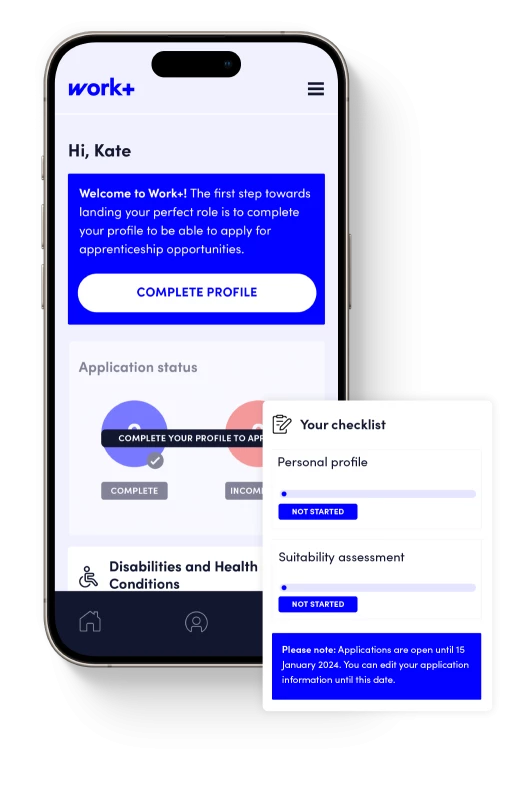
There are three sections to the Workplus application:
My profile – this section is open throughout the year. It includes your qualifications or predicted grades, work experience, and five 150–word questions.
My apprenticeship application – this section unlocks during the application campaigns and is where you select the apprenticeships you want to apply to, as well as rank employers.
Aptitude test – this is optional, but we recommend that you complete this. It only takes around 35 minutes and can be quite fun! It helps employers see more than just a written application form from applicants. Make sure to complete it before the deadline.
If you have a disability or a long–term health condition, you can access support from Disability Action to help you with your application.
To have a conversation about the support you can receive, email MichaelMoore@disabilityaction.org.
Alternatively, you can speak to either by calling 028 9029 7880.
We advise that you do this as soon as possible – we recommend contacting Disability Action at least 4 days before you submit your Work+ application to allow sufficient time for support.
Disability Action will aim to respond to your contact within two working days.
*NB: Disability Action is not able to advise on the content of your application.
Disability Action supports people with disabilities through the ApprenticeshipsNI Programme. We work with you, your employer, and your training provider to help you succeed. This includes mentoring, advice, and support in the workplace and in off-the-job training. We also run Workable (NI), offering workplace coaching, job retention support, and practical adjustments.
Contact: eandsmanagers@disabilityaction.org
Currently, apprenticeships at every level in Northern Ireland are funded by the government for all ages.
Based on previous campaigns, here is a rough guide of what employers might choose to pay their apprentices:
Level 2, £13,000
Level 3, £15,000
Level 4, £16,500
Level 5, £18,000
Level 6, £19,000
Level 7, £21,000
Salaries are at the employer’s discretion. During our application campaigns, employers state the salary for that particular job role.
Draft your answers on a Google Doc. Jot down all your thoughts, and as you keep reading over them, condense your answers to be what’s most impressive!
Ask for help and advice – talk through your application with a parent, teacher, friend or Careers adviser. Someone who knows you well will be able to help you think through your top skills and achievements. You won’t want to miss anything!
Remember that employers are reading your application – they want to find talent. Show your passion and interest for the apprenticeship that you are applying to.
Check over your answers – read over your application yourself, and get someone else to read over your application. Look out for typos, spelling, punctuation and grammar.
If you have a disability, we recommend contacting Disability Action early. They help make sure the application process and next steps work for you. We can help by connecting you directly with our trusted partners at Disability Action.
An apprenticeship is a job with training built–in. It’s the best way to develop new talent. Through on–the–job and off–the–job learning, an apprentice is considered a full–time employee and earns a good wage, whilst avoiding student debt (government pays their student fees).
An apprenticeship is a full–time job. We’ve found that 95% of apprentices stick with the company they’re working in after their apprenticeship, and they’ve already had years of experience.
You can enter HLA provision if it is at a higher level to your achieved qualification, or if it is in a subject unrelated to your qualification.
During the Workplus application campaigns, you can view the live job opportunities available that year.
In the meantime, check out our YouTube channel to hear from apprentices, employers and Workplus. As a Workplus apprentice, you join a network of apprentices – check it out here.
We also have a mailing list, and if you would like to be kept up–to–date, sign up here.