


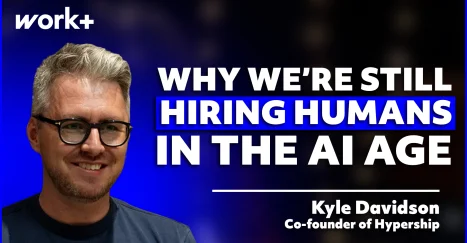
Kyle is co-founder of Hypership, an AI-native software consultancy, and it's his fifth business. Before that he spent twelve years at Kainos, growing from placement student to technology leader as the company grew to 3,000 employees.
He didn't plan any of it. He grew up in Ballybeen (Dundonald), took travel and tourism, ICT and business studies at A-level, and wanted to be a teacher. He got into university through clearing, taking a computing with education course. "I got in through clearing, so I maybe had a bit of a chip on my shoulder, that I needed to prove I deserve to be there."
His first module was programming with Java. He bought the textbook and taught himself from it, and started scoring excellent marks for the first time in his life. What clicked was the logic: "You're either right or you're wrong." A lecturer helped him switch into full computing in second year.
At 19 he applied for a Kainos summer scheme teaching students to build iPhone apps. Eight places, hundreds of applicants. He didn't get in, and the company's CTO rang to tell him so.
"I awkwardly asked, you don't have to give me any equipment, but can I just come along to the training and then I'll bugger off," Kyle says. The answer was yes. He turned up with a pen and paper and wrote the code out by hand. "They couldn't get rid of me after that!"
That summer he built an app for families with someone in their life with autism. "This was the first time in my life that I was going, oh, so you can create software to help other people."
Twelve years at Kainos followed, then a run of businesses ventures. He spent nine months building his first product and assumed people would arrive. "I built something and I was like, where are the people that will pay for this?" He now describes a business as a door with three handles: product, engineering, and sales/marketing. Having all three is essential for a software company to thrive.
His view of AI isn't that the models suddenly learned to code. It's that context windows grew from a few thousand words to around a million, which is what lets AI read and reason over an entire codebase. "I haven't written a line of code in the last two years, yet I have created more software than I ever have."
Asked whether he trusts it, his answer is a flat "I don't." There isn't a day, he says, where some correction isn't needed. The difference between him and someone with no training is that he ‘look under the hood' and check. He has a word for the alternative: vibe coding, where something looks like it works and nobody checks whether it does.
And what’s his approach to early talent in an age of AI? Hypership hired Anna, 19, who is doing a Higher Level Apprenticeship. Anna works four days a week with Hypership and attends uni on one day a week. She's learning to code without AI, the same way Kyle was taught. His advice for young people is to use AI with intent, and not to skip the part where you learn something yourself.
"There's this narrative that, as a result of AI, the need for junior developers has died. I disagree," he says - and highlights that today’s early talent are tomorrow’s future leaders.
For parents, teachers and young people weighing up career choices, Kyle's story shows that careers a full of twists and turns, failure and opportunity. Now an award-winning software engineer, Kyle’s journey into software began with getting into uni through clearing, finding his first job through a rejection, then by asking an awkward question and turning up anyway.
Watch the full episode - https://youtu.be/memVsQkCc_g